The Bridge Gets a New Home
There are moments in the life of an organization when everything that has been quietly building beneath the surface finally breaks through into something visible. A publication finds its voice. A website becomes more than a digital brochure. A newsletter stops being a newsletter and starts being a conversation. For RiverWise — the Aliquippa, Pennsylvania-based nonprofit organizing community voice and power along the rivers of Beaver County — that moment is now.
RiverWise has launched a new website at getriverwise.com, built by the web development studio Iliad, and with it, has given a permanent, polished, and fully public home to The Bridge, its community newsletter that has been quietly doing some of the most important local storytelling in southwestern Pennsylvania for the better part of the last several years. If you haven't heard of RiverWise, or if you've heard of them but not visited the new site, or if you've visited the new site but haven't yet subscribed to The Bridge, then this article is for you. Settle in. We have a lot to cover.
First, Who Is RiverWise?
Let's start at the beginning, because RiverWise is the kind of organization that deserves to be properly introduced, not rattled off in a clause.
RiverWise is a nonprofit based at 801 Franklin Avenue in Aliquippa, Pennsylvania, and its mission is, in its own words, to empower communities to build a better future. Specifically, RiverWise organizes community voice and power so that residents can reclaim agency over the future of communities along the rivers of Beaver County, PA. The word "reclaim" is doing a lot of work in that sentence, and it's doing it intentionally. Beaver County, for those unfamiliar with the geography and the history, is a place that has been shaped — and in many ways battered — by the forces of heavy industry, economic transformation, and the long, painful aftermath of deindustrialization. It is a place where, for decades, the story being told about the region was being told from the outside, by people who didn't live there, and the story was almost always a story of decline.
RiverWise exists to tell a different kind of story. Not a falsely optimistic one, not a boosterish one, not a story that pretends the challenges aren't real, but an honest story — one that centers the people who are actually there, actually building lives, actually imagining futures for the region, and actually doing the work.
The organization was intentionally founded to help connect residents to their rivers. The rivers of Beaver County — the Ohio, the Beaver, the tributaries that wind through postindustrial landscapes and past communities that are, despite the headlines, very much alive — are not just geographical features. They are part of the cultural identity of the place, part of its history of industry, part of the environmental challenges the region faces, and, increasingly, part of a vision for what the region's future could look like. RiverWise began with a focus on those rivers, but it quickly became clear that the needs of the communities they serve go well beyond any single issue.
As the organization's own framing puts it: they quickly realized that the needs and opportunities facing their communities are far more extensive than the river issue alone. So they expanded, willingly, into a wider range of work — project identification, project management, partnership building, resource development, community storytelling, and environmental advocacy — all in service of organizing community voice and power in more strategic, resilient, and sustainable ways.
What that looks like in practice is a remarkable body of work. RiverWise has produced the SWPA Environmental Storytelling Project. They have supported the RISE Project, which examines how federal funding is creating local energy innovation. They have convened the Summer Sustainability Institute. They have published a Guide to Community Benefits. They have produced Boom and Bust, a documentary film that traces a journey from Beaver County to the Gulf Coast region, examining the cycles of economic extraction and community resilience. They have launched the Justice 40 Opportunity Navigator, a project developed in partnership with New Sun Rising designed to help communities access federal Justice40 funding opportunities. And throughout all of it, they have published The Bridge.
What Is The Bridge, Exactly?
The Bridge is RiverWise's community newsletter. It has been published monthly (or thereabouts — community organizations move at the pace they can sustain, and that's as it should be) and distributed via email, reaching subscribers with community news, resources, and stories about their neighbors. The newsletter's subtitle says it plainly: Community Stories about our Neighbors in Beaver County.
That subtitle is doing a lot of work too. It is not Community Announcements about Beaver County Government. It is not Environmental Updates from the Rivers of Western Pennsylvania. It is not Nonprofit News from RiverWise HQ. It is community stories about neighbors. That is a different kind of journalism, and a different kind of communication, than most organizations attempt.
The newsletter is, in the organization's own framing, a prototype — a prototype for what RiverWise envisions as a growing center for relevant community news and resources for Beaver County residents. The word prototype matters here too. RiverWise is not claiming The Bridge is finished, complete, perfected. They are saying it is a proof of concept. A first iteration. A demonstration of what community storytelling can look like when it is done with care, with local focus, with genuine investment in the people being written about. And if the archive of past editions is any indication, that prototype has already proven itself.
Scrolling through the archive of The Bridge editions now living on the RiverWise website, you can trace the growth of the publication over time. The earliest editions, some of which date back to late 2023, carry the energy of something figuring itself out — finding its voice, establishing its cadence, learning what its readers need. The more recent editions, from late 2024 and into 2025 and 2026, carry a different kind of confidence. The newsletter has found its rhythm. It knows what it is. It knows who it's for. It knows why it matters.
More than two dozen editions now live in the archive. Each one is a document of a specific moment in the life of Beaver County's communities. Each one is a record of the things neighbors were dealing with, caring about, celebrating, grieving, and working toward in a particular month. Taken together, they constitute something approaching a community newspaper — exactly the kind of local storytelling infrastructure that has been systematically defunded and dismantled across the country over the past two decades, and exactly the kind of thing that RiverWise, with considerably fewer resources than a traditional newspaper, is attempting to rebuild.
To subscribe, readers can visit the newsletter's home on Letterhead at read.letterhead.email/the-bridge. And now, for the first time, they can also discover The Bridge through the beautifully redesigned RiverWise website.
The Website: What Iliad Built, and Why It Matters
Here is where we pivot to talk about a new website — and about the studio that built it.
Iliad is a web development and design studio that builds, in their words, high-conversion websites to elevate your business. They are a five-star rated shop (Google, for those keeping track) that offers design, development, marketing, maintenance, hosting, and SEO. Their tagline is an invitation: See what makes us epic. Their sub-tagline, which may be the most self-consciously dramatic thing you can say about a web development studio, is Start your odyssey.
The Greek epic branding is not accidental and it is not ironic. Iliad has leaned into the mythology fully — the company name evokes Homer's great poem of war and glory and homecoming, and the language they use to describe their work is saturated with the imagery of the heroic and the elemental. Where other agencies might describe their work as "solutions" and "deliverables," Iliad talks about odysseys. Their premium package, aimed at purpose-built solutions for purpose-driven clients, is called — naturally — Odyssey.
Their portfolio includes work that ranges from Logstown Lofts (historical roots, modern living, with a web presence to match — a project steeped in the local history of western Pennsylvania, since Logstown was a significant location in colonial-era trade and diplomacy along the Ohio River) to the Genesis Collective (empowering a non-profit through dynamic web presence) to Atlas CMS (a content management system they describe as bridging the gap between developers and users). It is a portfolio that demonstrates range: residential development, nonprofit work, software tooling. And now, prominently, RiverWise.
What Iliad has built for RiverWise is immediately evident when you land on getriverwise.com. The site opens with a video background — cinematic, river-inflected, the kind of visual storytelling that signals this is not a generic nonprofit template. The hero section makes a bold declaration before you've read a single word of content: Real Communities. Real Change. The type is confident. The layout is clean. The navigation is clear and purposeful. There is a donate button exactly where it should be.
What Iliad understood about this project — and what is evident in every design decision on the site — is that RiverWise is not merely an organization that needs a website. RiverWise is a storytelling organization. It exists to produce narrative, to share images and video and words that shift the way people understand Beaver County and the people who live there. A website for an organization like that cannot just be a container for information. It has to be an experience. It has to communicate, at the level of design and motion and typography, the same values that the organization communicates at the level of journalism and advocacy.
The new site does that. The featured projects section presents the breadth of RiverWise's work without overwhelming the visitor. Each project gets a thumbnail, a headline, and a link — enough to convey the scope and character of the work without turning the homepage into a wall of text. The site's structure leads the visitor naturally from the big picture (what RiverWise is and does) to the specific (the projects, the newsletter, the film, the justice 40 work) to the actionable (contact, donate, subscribe).
The Bridge page, in particular, is beautifully executed. The archive of newsletters is laid out visually, with thumbnail images of each edition serving as both navigation and invitation. You can see, at a glance, the history of the publication — the covers of more than two dozen editions, each one a distinct visual artifact from a specific moment in the newsletter's life. It is an archive in the truest sense, a record of community storytelling over time, made browsable and beautiful by the people at Iliad.
Why a Newsletter Still Matters — Especially This One, Especially Here
We are living in an era of profound crisis in local journalism. The statistics are staggering and, by now, familiar to anyone who has been paying attention. Thousands of local newspapers have closed. The ones that haven't closed have been hollowed out by hedge fund ownership, relentless cost-cutting, and the collapse of the advertising revenue model that sustained them for a century. Local television news survives but is increasingly consolidated, corporate, and focused on crime and weather and whatever generates clicks. The result is a landscape of what researchers have taken to calling "news deserts" — communities where there is no longer any meaningful local journalistic institution covering the things that matter to the people who live there.
Beaver County is not immune to this dynamic. Western Pennsylvania has seen the same forces of media consolidation and collapse that have affected the rest of the country. Communities that once had robust local papers covering school board meetings and zoning decisions and the lives of local residents now have very little. The things that happen in those communities — the good things, the hard things, the organizing and the grieving and the celebrating and the fighting for something better — largely go undocumented and unshared.
The Bridge is a partial response to that crisis. It is not a newspaper. It does not have the resources of a newspaper. It cannot do everything that a full newsroom could do. But it can do something, and that something matters. It can show up in people's inboxes once a month with stories about their neighbors. It can remind readers that they are part of a community, that other people in that community are doing things worth knowing about, that the place they live in has a story that is worth telling and worth reading.
There is something profoundly political about that, in the deepest sense of the word — political not as partisan but as civic. When RiverWise publishes The Bridge, they are making a claim that Beaver County residents deserve to be informed and connected. They are making a claim that local stories are worth telling with care and craft. They are making a claim that community, when it is organized and given voice, has the power to shape the future of a place. That claim is the same claim that underlies every other piece of RiverWise's work, and The Bridge is one of the most direct and immediate expressions of it.
The Iliad Partnership: What It Means for Purpose-Driven Organizations
It is worth pausing to appreciate what the RiverWise–Iliad partnership represents, because it is not the most obvious pairing in the world, and the fact that it works says something interesting about both organizations.
Iliad is a web development studio that uses the language of epic ambition — odysseys and glory and the heroic — to describe what is, at its core, a craft practice. Building great websites is not glamorous work in the way that founding a nonprofit to fight for environmental justice is glamorous work. It is technical work, detail-oriented work, the work of understanding how humans navigate interfaces and what visual design communicates emotionally and how fast a page needs to load before a user bounces. It is the kind of work that, when it is done well, is largely invisible — because when a website works beautifully, you don't think about the website, you think about the content.
That invisibility is the highest compliment you can pay to a web studio, and it is a compliment that Iliad has apparently earned. Their 5.0 star rating on Google suggests that the clients who have worked with them come away satisfied, which in the competitive and sometimes fraught world of web development is no small thing. Their portfolio suggests they have genuine range — they are not a one-trick shop that produces the same template in different colors for different clients, but a studio capable of adapting their aesthetic and technical approach to the specific character of each project.
For RiverWise, Iliad chose an approach that honors the organization's visual identity and mission without being heavy-handed about it. The site is bold without being aggressive, clean without being sterile, and narrative without being overwrought. It feels like a place you would want to spend time, which is exactly what a website for a storytelling organization should feel like.
For Iliad, meanwhile, the RiverWise project represents exactly the kind of work that their Odyssey tier is designed for — purpose-built solutions for purpose-driven clients. There is something satisfying about a web studio whose premium offering is designed specifically for clients who are trying to do something meaningful in the world. It suggests a set of values that goes beyond the purely commercial, an understanding that the best work often happens when a skilled craftsperson and a deeply committed client are working toward something that genuinely matters.
On Aliquippa, on Beaver County, on Western Pennsylvania
It would be incomplete to write about RiverWise and The Bridge without writing at least a little about the place they serve — because place is not incidental to what RiverWise does. Place is the point.
Aliquippa, Pennsylvania, where RiverWise is headquartered on Franklin Avenue, is one of the most storied communities in the history of American industry. For much of the 20th century, it was home to one of the largest steel mills in the world — the Jones & Laughlin Steel Corporation's Aliquippa Works, which at its peak employed tens of thousands of workers and was the economic engine of the entire region. The steel industry shaped Aliquippa's physical landscape, its demographic composition (workers came from dozens of countries), its political culture, and its sense of itself.
When the steel industry collapsed — beginning in the late 1970s and continuing through the 1980s — Aliquippa was among the hardest hit communities in the country. The jobs disappeared almost overnight. The population plummeted. The tax base collapsed. The infrastructure deteriorated. The story that got told about Aliquippa in the national media, on the rare occasions it was told at all, was a story of everything that had been lost.
But Aliquippa has also been producing something else in the years since: artists, athletes, activists, organizers, and entrepreneurs who have stayed, or who left and come back, or who have come from elsewhere and chosen to plant themselves there, because they believe in what the place can become. RiverWise is part of that current. The Bridge is part of that current. The new website is part of that current.
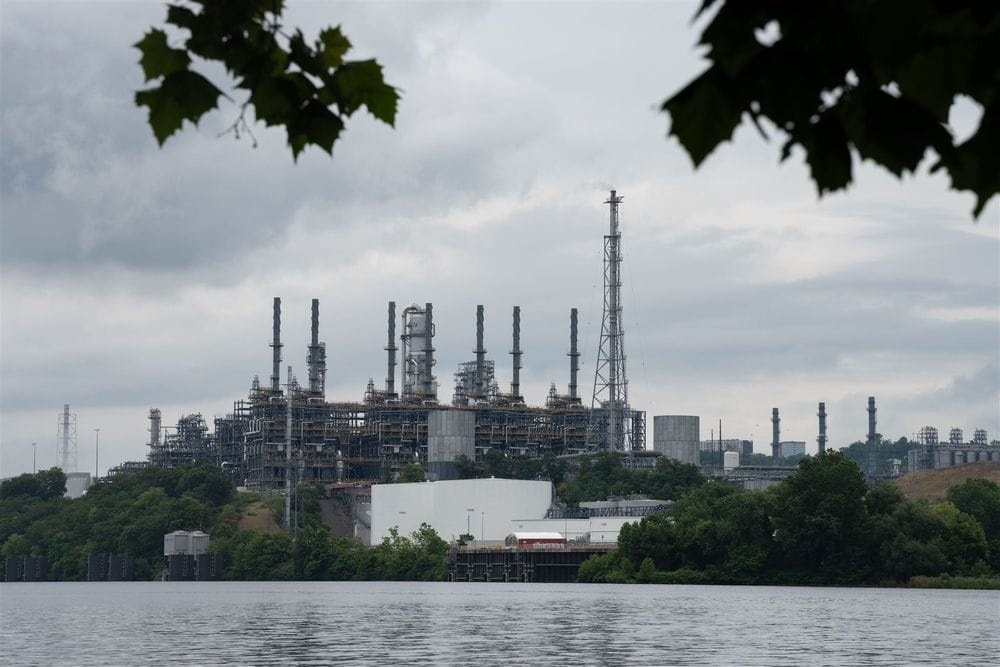
Beaver County more broadly — the patchwork of boroughs and townships and small cities that make up the county along the Ohio and Beaver rivers — is a place of extraordinary complexity. It is a place grappling with environmental challenges, including the legacy of industrial pollution and the ongoing controversies around new industrial development, including the Shell petrochemicals facility in Potter Township that has brought both jobs and controversy. It is a place with deep roots in labor organizing. It is a place with significant natural beauty — the rivers themselves, the hills, the remnants of forest. It is a place that has been left behind by some of the forces of the modern economy and is trying to figure out, collectively and sometimes contentiously, what comes next.
RiverWise exists in the middle of that complexity, and The Bridge exists to make that complexity legible to the people who are living inside it. That is not a small thing.
The Justice 40 Navigator and the Larger Vision
Before we close, it is worth noting that The Bridge and the new website are not the only things RiverWise has been building. Their newest initiative, the Justice 40 Opportunity Navigator, represents a significant expansion of their work into the territory of federal policy and community economic development.
The Justice40 Initiative is a federal commitment to deliver 40 percent of the overall benefits of certain federal investments to disadvantaged communities. It is, if implemented faithfully, one of the most significant tools available for directing resources toward communities like those in Beaver County that have borne a disproportionate share of the costs of industrial development and environmental degradation. But — as with so many federal programs — the gap between the policy's intent and communities' ability to access the resources it promises is enormous. Navigating federal bureaucracy, understanding which programs qualify under Justice40, writing competitive grant applications, complying with reporting requirements: these are not skills that most community organizations have in abundance.
The Justice 40 Opportunity Navigator, a project of RiverWise and New Sun Rising, is designed to help close that gap. It is an effort to make federal resources accessible to communities that need them — which is, in miniature, what RiverWise does across all of its work. Whether it is The Bridge (making community information accessible to residents), or the new website (making RiverWise's story and projects accessible to the public), or the J40 Navigator (making federal resources accessible to disadvantaged communities), the throughline is always access. Democratizing what is known. Democratizing what is available. Ensuring that people have what they need to exercise their agency over their own futures.
Subscribe to The Bridge. Explore the New Website. Start Your Odyssey.
If you have read this far, you are either someone with a deep interest in community journalism, nonprofit communications, western Pennsylvania, web design, or some combination of all four. Whoever you are, there is something here for you.
If you are a Beaver County resident, or someone who cares about Beaver County, you should subscribe to The Bridge at read.letterhead.email/the-bridge. It arrives in your inbox and it tells you stories about your neighbors, and those stories matter more than almost anything else that lands in your email on a given month.
If you are someone interested in what local organizations can accomplish when they commit to doing the work with care and seriousness, you should spend some time on getriverwise.com — the new site, the one Iliad built — and look through the archive of projects and the back issues of The Bridge and the pages about the Justice 40 Navigator and the documentation of everything RiverWise has put into the world over the years. It is an impressive body of work from an organization operating on nonprofit resources, and it deserves the kind of attention and support that impressive work deserves.
If you are an organization — a nonprofit, a small business, a community institution, anyone — that needs a website and has not yet found a web development partner that seems to understand what you are actually trying to do in the world, you should take a look at Iliad's work. Their portfolio includes the RiverWise site, and the RiverWise site is a good argument for what Iliad is capable of when they are given a client with a clear mission and the trust to execute.
And if you are someone who just wants to believe, even briefly, that it is possible for organizations with limited resources and large hearts to do meaningful work in difficult places — that community storytelling can still happen, that local journalism can still survive in some form, that a nonprofit founded to reconnect people to their rivers can end up doing something much larger and more important than that founding vision suggested — then all of this, all of what RiverWise has built and Iliad has helped them show to the world, is for you too.
The Bridge connects neighbors to each other. The website connects RiverWise to the world. And somewhere along the Ohio River in Beaver County, Pennsylvania, the work continues.
Visit RiverWise at getriverwise.com. Subscribe to The Bridge at the-bridge-demo.iliad.dev. Learn more about Iliad at iliad.dev. To support RiverWise's work, click the Donate button on their website.

Owen Rossi-Keen
Owen Rossi-Keen is the Founder and Principal Software Engineer at Iliad.dev, LLC, a web development agency focused on delivering enterprise-grade customization without the enterprise price-tag.
Pittsburgh, Pennsylvania